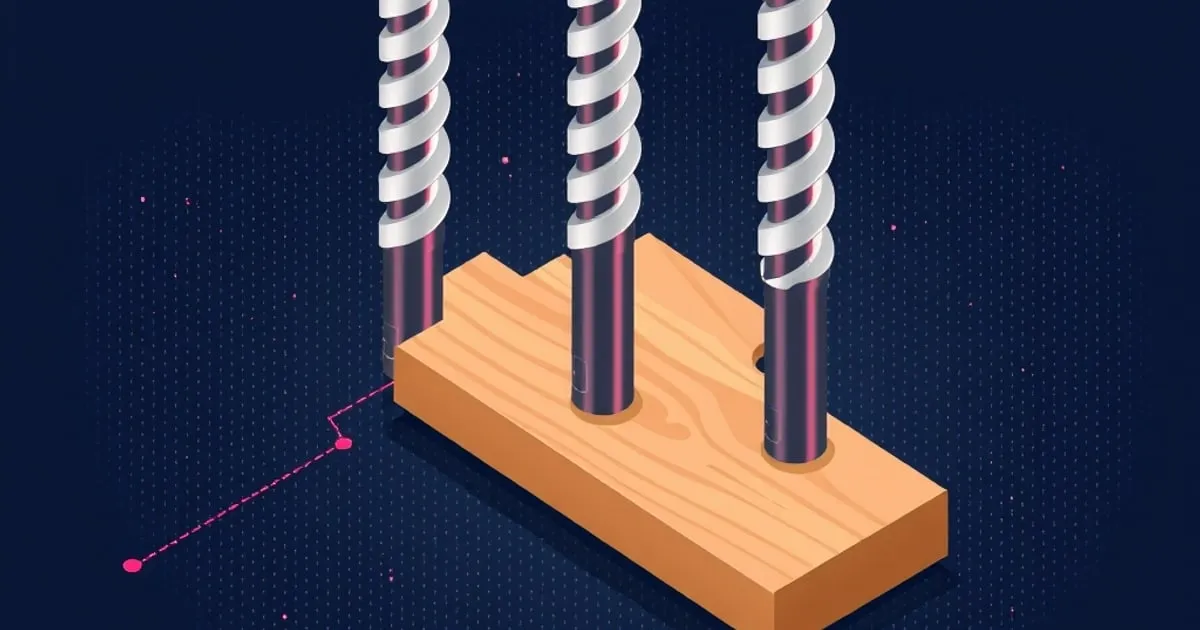
Upcut vs Downcut vs Compression CNC Router Bits
Compare upcut, downcut and compression CNC router bits by chip evacuation, edge quality, workholding and the wood jobs each geometry suits.
A spiral router bit has a helix, and the direction of that helix decides where the chips go. That single geometric fact drives almost everything people argue about when comparing upcut, downcut and compression cutters: which face of the board comes out clean, whether the part stays on the table, whether a pocket fills with hot dust, and how deep the first pass has to be.
The three geometries are not a quality ladder. They are three different answers to the question of which surface you care about.
Upcut spirals
An upcut spiral lifts chips out of the cut toward the spindle, in the same way a drill bit ejects swarf.
Because the flutes clear the cut aggressively, an upcut is the default for anything deep: pockets, slots, and full depth profiling in solid wood. Chips leaving the cut carry heat with them, which is the whole point of a healthy chip load, so an upcut is also the most forgiving geometry when the cut gets demanding.
The cost is the top surface. The same upward force that clears chips also lifts wood fibres at the top edge of the cut, producing fuzz or visible tearout there. On plywood or veneered stock, that means the face veneer at the top of the cut splinters. The bottom edge, by contrast, comes out crisp, because the fibres there are sheared upward into the supporting bulk of the workpiece instead of being lifted free of it.
There is a second, less obvious consequence: the upward force acts on the workpiece as well as on the chips. A thin or small part held only by tape can be pulled off the table. Deep slot in solid stock, clamped work, bottom face matters most: upcut is the answer.
Downcut spirals
A downcut spiral is the mirror image. It pushes chips downward, into the cut.
That gives a genuinely excellent top edge. The fibres at the top surface are pressed down as the cutter passes rather than lifted, so a downcut is what you reach for when the visible face is the top face: inlays, engraved surfaces, sign faces, veneered panels, anything where the top edge is going to be seen and touched.
It also holds the work down instead of trying to lift it, which matters more than people expect on light parts. Small pieces held on tape and glue, or parts cut free of a sheet, stay put considerably better under a downcut.
The problem is the chips, which now have nowhere to go. In a shallow profile pass the chips are pushed out ahead of the cutter and largely clear themselves. In a pocket or a slot the chips pack into the cavity, get recut, and turn into heat. Burning in a downcut pocket is a chip evacuation failure, not a feed rate failure, and no amount of feed adjustment fully solves it.
The practical rules that follow are simple. Use a downcut for shallow work and for through profiling in thin sheet. Avoid it in deep closed pockets. If a pocket has to be cut with a downcut for surface quality reasons, clear the bulk of it with an upcut first and leave only a finishing allowance.
The bottom edge of a downcut through cut is the weak face, so expect fuzz or blowout where the cutter exits into the spoilboard. A sacrificial backing and a spoilboard in good condition reduce it.
Compression spirals
A compression bit is an upcut and a downcut in one tool: an upcut section at the very tip, typically a short length above the end, and a downcut helix above it. The two opposing helices squeeze the material between them, so a through cut in sheet goods comes out clean on both faces at once.
That is the whole reason the geometry exists, and it is the standard choice for veneered plywood, melamine, laminate and any double sided sheet where both faces are visible.
The catch is that a compression cutter only does its job when both sections are engaged. If the first pass is shallower than the upcut portion at the tip, the tool behaves as a plain upcut and the top face tears exactly as it would with an upcut bit. The first pass has to be deep enough to bring the downcut section into the material, which means a compression bit is a poor fit for a very light machine that cannot take that first pass in one go, and a poor fit for stock thinner than the upcut section.
Compression cutters are also the most expensive of the three, and they gain nothing in blind pockets or in solid stock where only one face is visible.
Side by side
| Upcut | Downcut | Compression | |
|---|---|---|---|
| Chip direction | Up and out of the cut | Down into the cut | Up at the tip, down above it |
| Best face | Bottom | Top | Both |
| Weak face | Top, lifts and fuzzes | Bottom, blows out on exit | Neither, if the first pass is deep enough |
| Chip evacuation | Best of the three | Poor in pockets and slots | Good above the tip, poor at the very bottom |
| Effect on workholding | Lifts the part | Presses the part down | Roughly neutral |
| Deep pockets and slots | Yes | Avoid | Not the intended use |
| Through cutting sheet goods | Good, top face suffers | Good, bottom face suffers | The intended use |
| Thin or taped down parts | Risk of lifting | Preferred | Depends on stock thickness |
| Typical relative cost | Lowest | Similar to upcut | Highest |
Straight, ball nose and V bits
Three more geometries round out a realistic bit set.
Straight flute and O-flute cutters have no helix at all, so they neither lift nor press. Straight two flute cutters are cheap and fine for general slotting in softwood and MDF; single flute O-flutes, with their large polished flute valley, are the standard choice for plastics and are also useful in softwoods where gummy chip packing is the failure mode.
Ball nose cutters exist for three dimensional surfacing rather than for profiling. The cutting speed at the very tip of a ball is effectively zero, so the tip rubs rather than cuts, which is why 3D finishing passes are normally run with the tool tilted or with a stepover small enough that the flank rather than the tip does the work.
V bits cut with a conical point and are the tool behind V-carving and engraving. Their effective diameter changes with depth, so the cutting speed changes with depth too, which is why V-carve toolpaths are usually run conservatively and why a chip load calculated for a straight cutter does not transfer to them.
Surfacing and spoilboard cutters are wide, shallow, low RPM tools for flattening a wasteboard or a slab. Their diameter is large enough that surface speed becomes the limiting factor, so they run at a small fraction of the RPM used for a 1/4 inch cutter.
Flute count is a separate decision
Helix direction and flute count are independent choices, and confusing them causes a lot of burnt wood.
Flute count divides the feed rate: at a fixed feed and RPM, every extra flute makes each chip thinner. Wood produces bulky chips that need somewhere to go, and more flutes means smaller flute valleys, so a four flute cutter in wood tends to pack, rub and scorch. One and two flute cutters dominate wood work for both reasons at once.
The arithmetic and the material specific starting ranges are in the CNC chip load chart for wood, and the cut direction, depth of cut and stepover choices that follow are covered in climb vs conventional and stepover on a CNC router. Once you have picked a geometry, put the diameter and material into the feed rate and chip load calculator to get a starting feed.
Material, coating and shank
Nearly all CNC router tooling for wood is solid carbide rather than high speed steel. Carbide holds an edge far longer at router spindle speeds and tolerates the abrasive resin in MDF and particleboard, which shortens HSS edge life dramatically. HSS survives mainly in inexpensive handheld router bits.
Coatings matter less in wood than in metal, because the failure mode is abrasion and resin buildup rather than heat at the edge. What does help is a polished flute finish, which resists the pitch and resin buildup that turns a sharp cutter into a burnishing tool.
On shanks, a 1/4 inch shank is the desktop standard and 1/8 inch is common for detail work. Prefer the shortest cutter that reaches through your stock: stickout is a lever, and deflection rises steeply with it, so an unnecessarily long bit produces tapered walls and chatter on exactly the light gantries that can least afford it.
Choosing by job
- Through cutting veneered plywood or melamine, both faces visible. Compression, with a first pass deep enough to engage the downcut section.
- Deep pocket in hardwood. Upcut, shallow passes, generous stepover on the roughing pass.
- Inlay or engraved top surface. Downcut, shallow depth of cut, light finishing pass.
- Small parts held on tape and glue. Downcut, so the tool presses the part down rather than lifting it.
- Slotting in softwood or acrylic. Single flute O-flute, which clears bulky chips instead of packing them.
- Flattening a slab or resurfacing the wasteboard. Surfacing cutter at low RPM, wide stepover, very shallow passes.
- 3D relief carving. Upcut or ball nose for roughing, ball nose for the finishing pass.
The pattern behind that list: decide which face has to be clean, then pick the helix that presses that face rather than lifting it, then check that the chips still have somewhere to go. When those two requirements conflict, either split the job into a roughing pass and a finishing pass, or pay for a compression cutter.
Machine rigidity and spindle RPM range determine how much of this you can actually use, since a compression cutter needs a first pass most light machines find demanding. That side of the decision is covered in the desktop CNC router buying guide for woodworking.
Sources
Related

CNC Chip Load Chart for Wood: Feeds and Speeds
Starting chip load ranges by bit diameter and material, the feed rate formula behind them, and how to correct burning, chatter and fuzzy edges.

How to Fix Tearout on a CNC Router: Bit, Toolpath, Feed
Tearout on a CNC router is wood splitting ahead of the cutting edge. Fix it with bit helix, a 0.3 to 0.5 mm finishing pass, chip load and fibre support.

Climb vs Conventional and Stepover on a CNC Router
Which way to run the cutter, how deep each pass should go, and how far to step over, once chip load is set on a flexing desktop machine.